
The femtosecond laser is a highly advanced photonic technology already widely used in the industrial and scientific world. Thanks to its ultrashort pulses, it enables processing of all types of materials with extreme precision. This process, initially reserved for research, is now at the heart of many cutting-edge industrial applications. In this article, we offer a clear and accessible introduction to the femtosecond laser: its operation, its technological advantages, and its uses in modern industry.
What is a femtosecond laser?
A femtosecond laser is a type of ultrashort-pulse laser whose emission duration is measured in femtoseconds (1 femtosecond = 10⁻¹⁵ second). To put this in perspective, a femtosecond pulse is to one second what 1 second is to 31 million years: this illustrates just how short this duration is.
These ultrashort pulses enable energy transfer to the material almost instantaneously, before heat has time to propagate. This is referred to as an “athermal laser”, because there is little to no thermal diffusion, unlike conventional nanosecond or continuous-wave lasers commonly used in industry.
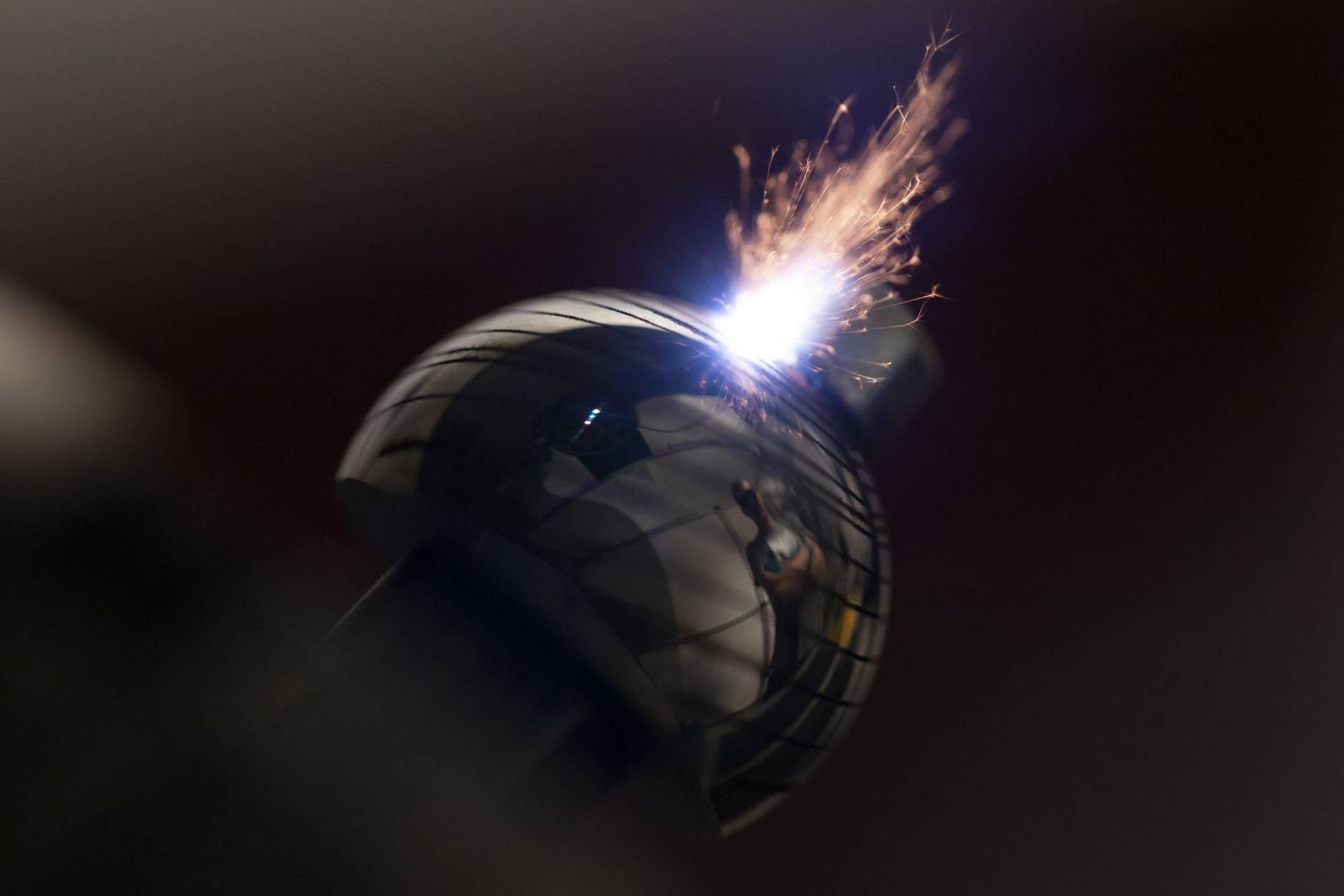
Key Advantages of the Femtosecond Laser
The use of the femtosecond laser offers numerous benefits, particularly in contexts where precision, cleanliness, and material preservation are critical.
Here are the main advantages:
- Minimal heat-affected zone (HAZ): processing with ultrashort pulses limits thermal effects (no melting, no cracks, no burnt residue).
- Machining of sensitive or complex materials: the femtosecond laser can process glass, polymers, metals, composites, bi-materials, or even biological structures without altering their properties.
- Sub-micrometric resolution: it enables cutting, drilling, or engraving with very high precision, down to the nanometric scale depending on settings.
- Non-contact, wear-free process: unlike conventional mechanical machining, there is no mechanical stress and no tool that wears or deforms.
- High application flexibility: a single laser source can be used for different types of materials or processes by adjusting parameters.
What are the industrial applications of the femtosecond laser?
The femtosecond laser became widespread in the early 2000s, thanks to its use in eye surgery (LASIK).
Thanks to its exceptional performance, the femtosecond laser has established itself in numerous industrial and technological sectors. Here is a non-exhaustive list:
Precision Micro-Machining
- Engraving of microcircuits
- Cutting of electronic components
- Drilling of holes a few microns in diameter
Medical Devices
- Cutting of stents or implants with tolerances below 1 µm
- Fabrication of micro-needles or microfluidic devices
Electronics and Semiconductors
- Structuring of silicon wafers
- Invisible marking of sensitive parts
- Processing of transparent or multilayer materials
Surface Treatment and Texturing
- Creation of anti-reflective, superhydrophobic, or adhesive structures
- Surface modification without degrading mechanical properties
Aerospace and Automotive
- Micro-cutting of sensors
- Treatment of technical coatings
What about applied research? The role of Manutech USD
As a technology platform based in Saint-Étienne, Manutech USD supports companies in the development and transfer of femtosecond laser technologies to their industrial processes. Through a cutting-edge environment combining fundamental research transfer, industrial equipment, and technical expertise, we help transform laser innovation into concrete solutions for industry.
Conclusion
The femtosecond laser has established itself as an essential technology in fields where precision, processing quality, and innovation are critical. Whether for micro-fabrication processes, surface treatments, or biomedical applications, it opens the way to technical possibilities that were previously inaccessible.
Would you like to learn more or explore integrating the femtosecond laser into your processes?
Contact our teams at Manutech USD to discuss your project.